REVIEW · AUCKLAND
Auckland City Self Guided Walking Tour with an APP
Book on Viator →Operated by Trippy Tour Guide · Bookable on Viator
Auckland on foot, guided by your phone. I like how this self-guided setup lets you control the pace, take breaks when you want, and still cover the core highlights. I also love the value, since you’re led from place to place where most stops are free and the app keeps everything moving.
The main thing to consider is that you’ll rely on your phone. If your battery is low or you don’t love walking for roughly 4 to 5 hours, plan ahead and keep your route practical.
In This Review
- Key highlights you’ll feel right away
- Walking Auckland’s Queen Street start to Parnell finish
- Te Komititanga Square and the Māori-inspired start that sets the tone
- Maori Chieftain Statue: dignified symbolism you’ll notice up close
- Ferry Building: the 1912 transport hub that still does its job
- Viaduct Harbour and the Wairau Creek Bridge: port history, modern waterfront
- Wynyard Quarter: old tanks and silos turned into a future-facing waterfront
- Victoria Park and St Patrick’s Cathedral: green reset and architectural punch
- Sky Tower: the skyline icon, with earthquake-resistant engineering in the story
- Auckland Town Hall: progressive activism in a civic setting
- Albert Park again, but with context: Victorian elegance on older ground
- University of Auckland Clock Tower: carved limestone symbolism for a quick pause
- Parnell Rose Gardens: finish strong with harbour views and 5,000 roses
- Price and pacing: why $9.99 works here
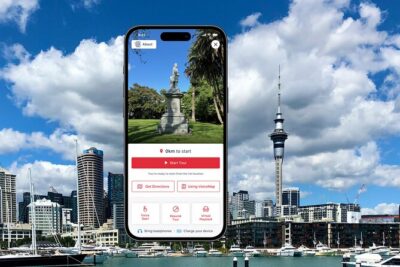
- The app-led experience: what you should expect on the street
- When this Auckland walk is the best fit (and when it isn’t)
- Should you book this Auckland walking tour with the app?
- FAQ
- How long is the Auckland city self-guided walking tour?
- How much does the tour cost?
- Where does the tour start and end?
- Is the tour self-guided, and do I get a mobile ticket?
- Are admissions included at the stops?
- What is the cancellation policy?
Key highlights you’ll feel right away

- An app that supports your pace, so you can stop for coffee or just linger at viewpoints without falling behind
- Mostly free admission stops, which makes the price feel fair instead of budget-y
- A smart route flow, starting in the CBD and gradually working toward Parnell for a satisfying finish
- Waterfront + city greens in one outing, with harbor history, modern reuse, and park resets
- Iconic Auckland landmarks, from Sky Tower to St Patrick’s Cathedral and the War Memorial Museum area nearby by context
- A clear end point at Parnell Rose Gardens, so your walk doesn’t feel like an endless loop
Walking Auckland’s Queen Street start to Parnell finish
This is the kind of Auckland day that works even if you hate rigid schedules. You start at the Dingwall Building on Queen Street (87/93 Queen Street), then follow your phone instructions to a string of landmarks and neighborhood moments. The tour ends at Parnell Rose Gardens, which is a great way to close: you finish with color, shade, and harbour views instead of another office-block exit.
The duration is listed as about 4 to 5 hours. That’s a realistic window for casual wandering, photos, and a coffee pause without turning your afternoon into a full-on hike. You’ll also be close to public transport for most of the route, which is handy if you want to shorten things.
Price is $9.99 per person. That’s low enough that you’re not paying for a long ticketed museum day; you’re paying for a guided route and an app that helps you understand what you’re seeing as you walk.
You can also read our reviews of more walking tours in Auckland



Te Komititanga Square and the Māori-inspired start that sets the tone
Your first stop is Te Komititanga Square, Auckland’s newest public space. The big idea here is the transformation: it’s been turned from a noisy roadway into a welcoming piazza that connects the city with the waterfront.
This is a good opening because it immediately answers the question What kind of Auckland is this? You get a modern public space designed with Māori-inspired paving patterns, and it feels like the city is thinking about connection rather than just traffic flow.
From here, you’re only walking a short stretch, so it’s easy to get your bearings fast—no long warm-up required.
Maori Chieftain Statue: dignified symbolism you’ll notice up close
Next you see the Maori Chieftain Statue, a bronze sculpture by Molly Macalister from 1967. It shows a peaceful rangatira wearing a ceremonial kaitaka cloak, and it pushes back on stereotypes in a subtle way: the sculpture includes a mere pointed down, which signals dignified leadership rather than aggression.
I like this stop because it’s not trying to be flashy. Up close, it changes how you read the street and public spaces around it—like you start noticing that Auckland’s landmarks include stories about identity, leadership, and representation, not only architecture.
It’s a quick visit—about 5 minutes—so don’t overthink it. Just look, read the signage prompts you’re given, and move on.
Ferry Building: the 1912 transport hub that still does its job
Then it’s on to the Ferry Building, built in 1912 in a Golden Edwardian Baroque style. This stop is basically a time machine for how Auckland has moved people for over a century, plus how public space plays a role in social life and memory.
The Ferry Building has connections to wartime farewells and social gatherings, and today it still functions as the transport heart with ferries and cafés. That combination—history plus daily use—is exactly why I like walking tours like this. You’re not only looking at a relic; you’re seeing something that’s still working.
If you want a break, this is a smart place for it. The setting makes it easy to pause without losing the thread of the day.
Viaduct Harbour and the Wairau Creek Bridge: port history, modern waterfront
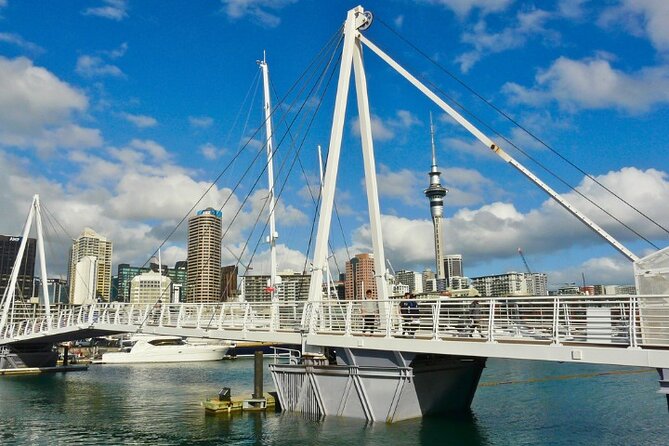
From the Ferry Building you head toward Viaduct Harbour, a former working port now turned into Auckland’s waterfront playground. You’ll see the shift immediately: superyachts, dining along the water, and strong ties to the America’s Cup story. Even if you don’t follow sailing, the area is built for views, people-watching, and late-afternoon atmosphere.
The Wairau Creek Pedestrian Bridge is the next stop, and it adds an engineering payoff. It’s a bascule drawbridge that lifts to let tall ships pass. That sounds technical, but it becomes a real-world moment when you’re standing there and thinking about how the city keeps moving while its waterfront remains alive with maritime activity.
This section of the route also gives you great harbour sightlines. If you’re the type who takes photos every time you see a new angle of water, you’ll be happy here.
You can also read our reviews of more guided tours in Auckland




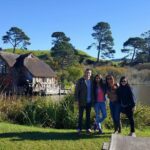

Wynyard Quarter: old tanks and silos turned into a future-facing waterfront
Wynyard Quarter follows, and it’s one of the most interesting “what happened here?” spots on the walk. The area is described as former oil tanks and silos reborn as sustainable waterfront hubs.
What you can actually notice on the ground is the shift from industry to community space. There are eco-friendly buildings, Silo Park events, and family-friendly fountains mentioned in the tour notes. Even if you don’t catch an event, the area reads like a city using its existing bones instead of erasing the past.
This is also a nice place to reset your rhythm. You’ve done a chunk of harbour history and movement already; now you get a section that feels more like a modern public gathering zone.
Victoria Park and St Patrick’s Cathedral: green reset and architectural punch
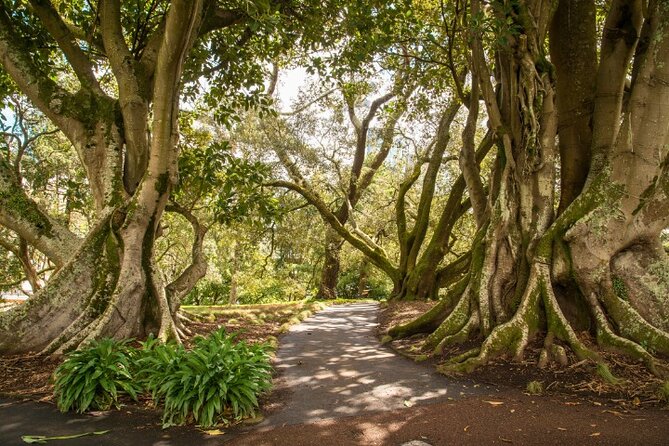
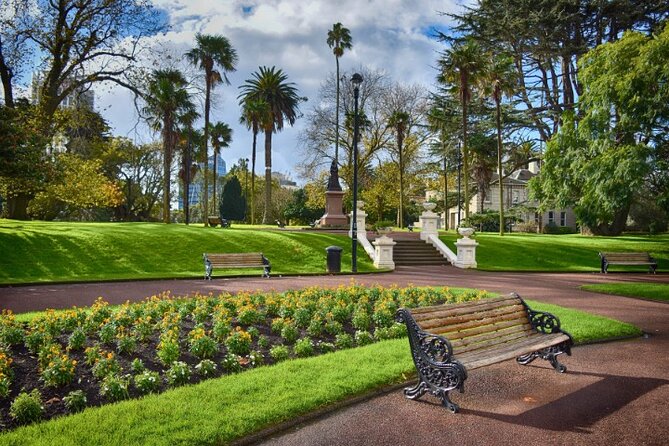
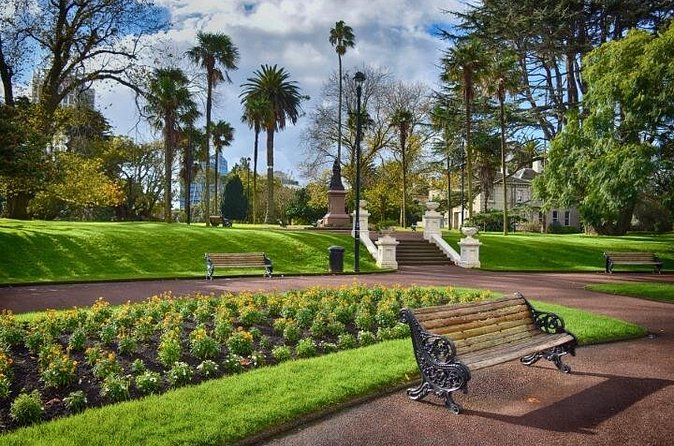
Next comes Victoria Park, described as Auckland’s giant green front lawn in the city center. This is a quick stop, but it matters. It gives you shade, trees, and open space right when you’ve been walking among buildings and waterfront views.
The park includes heritage trees, plus features like the Queen Victoria statue, Boer War cannons, and Aphrodite’s Fountain. The tour also frames the park as having layers, including links to the site’s former Māori pā history. Even without a long stop, this is the kind of park that makes you feel the city’s complexity.
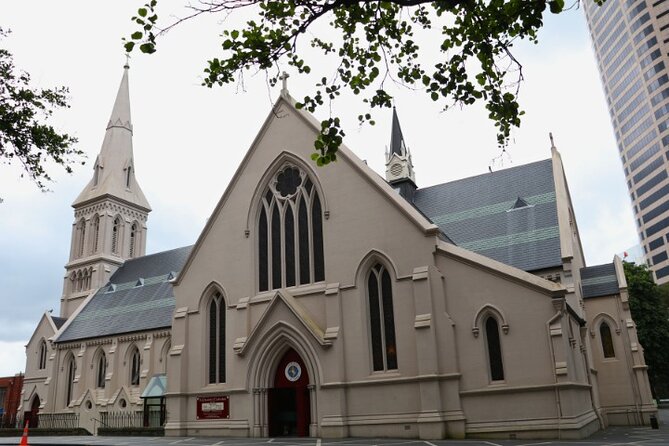
Then you hit St Patrick’s Cathedral, where the tour switches from mostly free to an included admission stop. It’s a Gothic Revival masterpiece built in volcanic scoria stone, from 1907. You’ll see why it’s described as New Zealand’s most significant heritage building, plus details like Roman bells, a London organ, and stained glass windows.
What I like here is the contrast. You go from modern waterfront and city streets into a building meant to focus attention upward. If your legs are starting to feel it, this is also a good moment to slow down inside and let the architecture do the heavy lifting.
Sky Tower: the skyline icon, with earthquake-resistant engineering in the story
Sky Tower is your big city landmark moment. It’s listed as the Southern Hemisphere’s tallest structure at 328m and a telecommunications hub and icon since 1997.
This stop also isn’t just a height brag. The tower is described as earthquake resistant, which is a detail worth remembering in a country where seismic events shape building design. You’re also given notes about SkyJump thrills and panoramic Auckland views.
Even if you don’t go up, the stop helps you understand why Auckland has this kind of central vertical landmark. The app cues you toward what to notice, so you’re not just taking a single photo and moving on.
For me, this is a perfect “middle-of-the-walk check-in.” You’ve already crossed waterfront areas; now you see how the whole city stacks up.
Auckland Town Hall: progressive activism in a civic setting
Auckland Town Hall is next, and it adds something you don’t always get on sightseeing walks: a social lens tied to a building. The tour notes describe it as progressive Gothic, with a focus on LGBTQ+ rights since the 1970s.
You can also look for historic bells from 1862 and the stone vaulting. The point of this stop is that architecture isn’t only aesthetics—it’s community meaning, and the tour frames the hall as more than a pretty façade.
If you’re someone who likes to understand the city behind the skyline, this is one of the most rewarding stops on the route.
Albert Park again, but with context: Victorian elegance on older ground
Albert Park is another green reset, and the tour gives you the context you need to read it well. It’s described as Victorian elegance on a former Māori pā site, so you’re seeing layers rather than a blank postcard lawn.
The tour highlights the ombu tree, the Queen Victoria statue, Boer War cannons, and Aphrodite’s Fountain—plus the way the park holds the complex story of Auckland. This isn’t a long stop, but it’s a great place to pause and think about how many meanings can fit into a space that looks simple at first glance.
Practical tip: take a slower walk through the park perimeter. You’ll get different angles on the trees and the civic-feeling surroundings without needing extra time.
University of Auckland Clock Tower: carved limestone symbolism for a quick pause
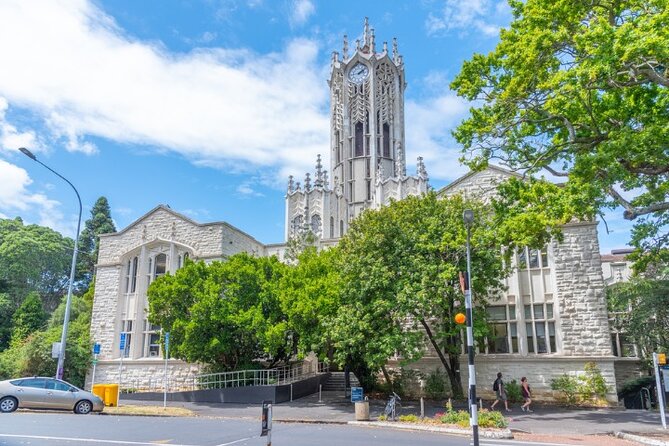
The University of Auckland Clock Tower is a short stop—about 5 minutes—but it’s the kind of thing you remember because of the details. It’s a neo-Gothic icon built in 1926, carved from limestone and decorated with mythical creatures and native plants.
The tour frames it as a symbol of knowledge where generations of graduates celebrated milestones. That’s a nice reminder that city landmarks aren’t only about government or churches; universities help shape a place too.
If you’re timing the day around photos, this is a good “grab-and-go” moment.
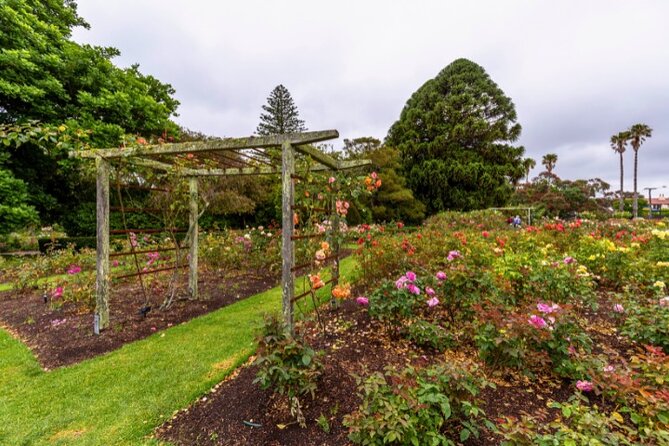
Parnell Rose Gardens: finish strong with harbour views and 5,000 roses
Your final stop is Parnell Rose Gardens. The tour describes 5,000 rose bushes cascading down the hillside, and that alone is a big reason to end here instead of finishing back downtown.
You also get Dove-Myer Robinson Park in the mix, named for the longest-serving mayor. And the tour notes the area as an unofficial engagement corner—so yes, it’s romantic, but it’s also simply a well-loved public space where people actually linger.
The harbour views make this ending feel like a reward for the walk you’ve already done. By the time you arrive, you’ve covered civic landmarks, architecture, waterfront history, and parks—so this is where the day clicks into “I get why people come back.”
Price and pacing: why $9.99 works here
At $9.99 per person, this tour doesn’t try to compete with expensive guided experiences. Instead, it delivers value through three things:
First, most stops have free admission. That means you’re paying for interpretation and direction more than tickets.
Second, you’re not forced into a tight group schedule. The app approach is built for personal timing, so you can pause for coffee, stretch your legs, and still stay on the path.
Third, the stops are chosen to form a logical city story. You start at the CBD edge, move through waterfront history and reuse, then head into civic and architectural highlights, and finish in a garden setting.
If you’re trying to see Auckland efficiently without spending a lot, this is one of the smarter ways to do it.
The app-led experience: what you should expect on the street
The tour is sold as a self-guided walking experience with an app, and it includes a mobile ticket. That matters because you’re not waiting around for meeting times or trying to match a guide’s pace.
The practical upside—also echoed in the experience’s overall feedback—is that the app works well for wandering at your own pace. It’s meant for a 4 to 5 hour window, so you won’t feel trapped once you’ve started.
The one real-world drawback is battery and data. Since you’re walking outdoors and checking prompts at each stop, bring a charged phone and, if you’re cautious, consider offline maps.
Also remember that this is a private tour/activity in the sense that only your group participates. With self-guided formats, that often just means fewer complications and no crowd-control juggling.
When this Auckland walk is the best fit (and when it isn’t)
This is best for you if:
- you want a strong Auckland overview without joining a full guided group
- you like mixing iconic landmarks with local, story-driven details
- you want flexibility for breaks and photos
It may not be ideal if:
- you dislike walking for several hours with only short pauses
- you expect a lot of indoor time beyond St Patrick’s Cathedral
- you don’t want to rely on an app while you’re moving around a city
Should you book this Auckland walking tour with the app?
I’d book it if you’re trying to see Auckland in a way that feels like yours. For $9.99, you get a structured route, helpful context at each stop, and the freedom to slow down where you care. Ending at Parnell Rose Gardens is a nice finish strategy, and the route covers enough variety—parks, civic buildings, waterfront change, and skyline energy—that you’ll leave with a real sense of the city’s shape.
If you’re on a tight budget but still want meaning behind the landmarks, this is a great call. Charge your phone, wear comfy shoes, and let the app guide your timing rather than your stress.
FAQ
How long is the Auckland city self-guided walking tour?
The tour duration is listed as about 4 to 5 hours.
How much does the tour cost?
It costs $9.99 per person.
Where does the tour start and end?
It starts at the Dingwall Building (87/93 Queen Street, Auckland Central) and ends at Parnell Rose Gardens in Parnell.
Is the tour self-guided, and do I get a mobile ticket?
Yes. It’s self-guided with an app and uses a mobile ticket.
Are admissions included at the stops?
Most stops are free. St. Patrick’s Cathedral includes admission on this tour.
What is the cancellation policy?
Free cancellation is available up to 24 hours in advance for a full refund. Changes made less than 24 hours before the experience start time aren’t accepted, and cancellations within 24 hours are not refunded.